The short answer: choose a small group if you want company and predictable cost, a private customized tour if you want the route to bend around you, and a large group if keeping the per-person cost as economical as possible is the deciding factor. Most travelers coming to Guizhou from Canada are happiest in the first or second category. This guide compares the formats on pacing, cost, flexibility and social atmosphere, with specific advice for travelers over 55 and for couples or friends in their 30s and 40s.
What actually changes with group size?
Large group (20–50 travelers). The coach is comfortable and the per-person price is the most economical. The trade-offs are fixed stops, longer boarding times and less room to linger at a viewpoint. If a traveler in the group moves slowly, the whole schedule adjusts around that pace. Large groups also tend to use larger vehicles that cannot reach the quieter lanes near a Miao village or the smaller guesthouses that make an overnight special.
Small group (up to eight). Shorter vehicle, quicker stops, and a real chance to talk with the guide. A small group can skip the crowded hour at a site or take the quieter lane through a Miao village. It costs more per person because the fixed vehicle cost is shared by fewer travelers. The difference is felt most at the gate and at the viewpoint: eight people clear a ticket check and board a shuttle far faster than forty, which frees up time that a large group spends waiting.
Private customized tour. You choose the vehicle, the guide, the hotel category and the daily pace. The route can be rewritten on the morning of a mountain day if the weather changes. This is the most expensive option and the most efficient use of a short holiday. It also solves the problem of differing abilities within a party, because the group can split and regroup without anyone missing a sight.
A side-by-side comparison
| Factor | Large group | Small group | Private |
|---|---|---|---|
| Typical size | 20–50 | Up to eight | Your party only |
| Per-person cost | Most economical | Moderate | Highest |
| Pacing | Fixed | Adaptable within the day | Fully flexible |
| Guide access | Limited | Direct | Dedicated |
| Vehicle access | Main roads only | Most sites | Narrow lanes and remote stops |
| Weather changes | Hard to adjust | Some room to swap | Easy to reorder |
| Social atmosphere | Busy and varied | Company without crowding | Just your group |
No row of this table is a verdict. It is a set of trade-offs, and the right choice depends on which rows matter most to you. A traveller who values conversation with a guide will rank that row highly; a traveller watching the total budget will rank cost first. Our six-day cost breakdown explains how to read the prices behind these categories honestly.
Which suits travelers over 55?
Many people in this group prefer the company and structure of a small tour rather than a fully private one. They want the cost known in advance, a guide who handles the tickets and a vehicle that does not leave them behind. Predictable pricing and the reassurance of travelling with others are consistent priorities for older North American travellers, and a well-run small group meets both.
A small group of six to eight, with a licensed guide and clearly listed inclusions, usually hits that mark. Ask about the walking at each stop before booking; a good consultant will tell you honestly which sections can be skipped. It is also worth checking the hotel category and whether rooms have lifts, because older properties in hill towns may not. Our senior-friendly route guide covers pacing, packing and mobility in more detail, and the before-you-go guide covers health preparations.
Questions worth asking before you book
Ask how many steps are involved at each site, whether a shuttle or cart is available, and what happens if a member of the group needs to stop. Ask whether the guide stays with the slower walkers or continues with the main party. Ask about the start time and whether it can be moved later after a long flight. These are ordinary questions, and a consultant who answers them plainly is likely to run a good tour. One who treats them as difficulties is telling you something useful too.
Which suits couples and friends in their 30s and 40s?
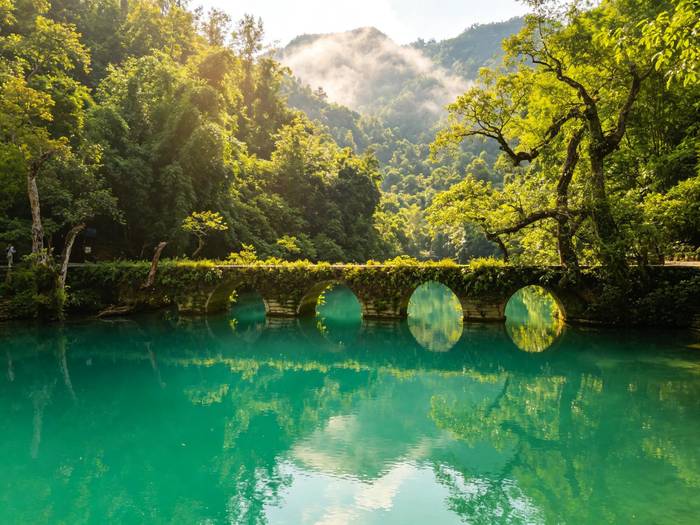
This group tends to buy experiences rather than itineraries: a photographer who needs the light at Wanfenglin, a couple who wants a second night in Xijiang, friends who would rather eat at a village table than a tour restaurant. A private customized tour delivers that, and the guide can adjust the day without asking a group for consensus. It is the format that best supports a specific interest, whether that is photography, food, crafts or simply more time in one place.
A small group still works if the departure is well designed — look for itineraries that include a free evening rather than a scheduled activity every hour. The key is to read the daily plan rather than the brochure. If every hour is accounted for, you will not get the quiet window you are hoping for; if there is open time, the guide can help you use it. Our seven-day itinerary shows how a route with built-in slack compare with a tighter loop.
What about solo travelers?
A small group is the natural fit. It provides company without the single-supplement cost that a private vehicle would imply. Solo travelers should confirm the single-room supplement in the written quote before committing, because it varies with the hotel category and the season. If you want a private departure as a solo traveller, the cost per person is highest, but the freedom to set the pace and the interests can be worth it on a once-in-a-lifetime trip.
Solo travellers often appreciate the small-group format most at meal times, when a table of six or eight makes the long-table lunch and evening meals more enjoyable. A guide also gives you someone to ask the small questions that couples can answer between themselves. Our no-shopping guide explains how to check what any format actually includes.
How do you compare the cost fairly?
Compare like for like: entrance tickets, local shuttles, meals, hotel category and guide. A low headline price that excludes the scenic packages is not better value than a slightly higher one that lists them. Kanghui Travel quotes in Canadian dollars, itemises local payments and requires no payment before you approve the itinerary. Ticket prices and shuttle arrangements can change; verify the current figures and conditions with the official source before travel. As a working conversion, we quote in Canadian dollars and treat one Canadian dollar as roughly 5.2 yuan, though the rate moves and any converted figure is indicative until confirmed in writing.
Canadian ordinary passport holders may be eligible for visa-free entry for stays of up to 30 days — verify the current policy and your eligibility with the official source before travel. The format you choose does not change the entry rules, but it can change how much help you get with the paperwork on arrival; a private arrival transfer and a guide waiting at the gate are part of what you are buying.
How the format changes the small moments
It is easy to compare group formats on price and pace, but the differences often show up in small moments. At the gate of a scenic area, a small group clears the real-name ticket check in one go while a large coach party forms a queue. At a viewpoint, eight people can step aside to let a family photograph the view; forty people move as a block. At the end of a long day, a small vehicle reaches a guesthouse tucked up a narrow lane that a coach cannot enter. These moments do not appear in an itinerary, but they accumulate into the feeling of the trip.
Guides work differently across the formats too. In a large group, the guide is often a voice on a microphone and a figure at the front of a queue. In a small group, the guide can answer a question while walking and adjust the route when the group has a specific interest. On a private tour, the guide becomes a companion who knows your preferences by the third day — which sights you linger at, which foods you avoid, and when you would rather have an hour to yourself. If interpretation and local knowledge matter to you, that difference is worth more than the line in the budget it occupies.
None of this makes a large group the wrong choice. Travellers who enjoy a busy social atmosphere and a set schedule often have an excellent week on a coach. The point is to match the format to the way you actually like to travel, rather than to the way you imagine you should. If you are undecided, the five-day loop is offered in more than one format, so the same sights can be compared directly before you commit.
Before you fly: a Canadian traveller's checklist
- Entry documents. Verify the current visa-free rules for Canadian ordinary passport holders with the official source before travel, and carry the passport used at booking.
- Payment. Set up a mobile wallet before departure if you plan to use one, and carry a backup card and a little cash. Ask your bank about international transaction fees.
- Connectivity. Arrange an eSIM or roaming plan in advance and download offline maps of your route. Save each hotel's Chinese name in your phone.
- Packing. Layers, a rain shell, shoes with grip and any regular medication in hand luggage. Group size does not change what you need to carry.
- Language. A licensed guide makes the biggest difference in a small group or private tour. Our language guide covers the wider picture.
The full checklist is in our before-you-go guide.
A simple way to decide
Write down three numbers before you book: your budget, your available days and the maximum number of steps you are comfortable with in a single morning. Those three answers usually settle the format. A tight budget with plenty of time points toward a larger group; limited time with a higher budget points toward private; most travelers in between are best served by a small group.
The social question matters too. Some people enjoy a table of eight at dinner; others want to travel only with their own family. Neither is a better choice. Be honest about which one recharges you, because a week of the wrong format is tiring in a way that no itinerary can fix. If you are travelling with others, agree on the format together before looking at prices; it is much easier to choose a route when the style is already settled.
Kanghui Travel offers all three formats on the same core routes, so the decision can be made on travel style rather than on which sights are available. The written quote states the group size, the guide arrangement and the included meals, which makes a fair comparison possible. If you want to see how the same sights are arranged across different lengths, the five-day loop and the seven-day itinerary are useful starting points.
Common questions
Can I upgrade from a small group to private mid-trip?
Often yes, subject to availability. Ask your consultant before departure so the vehicle and guide can be reserved. It is easier to arrange at the start of a trip than in the middle of a mountain day.
Are small groups quiet?
They are usually more relaxed than large groups, but much depends on the mix of travelers. Our itineraries include unscheduled time so the day does not feel programmed. If quiet is important to you, say so when you book.
Do private tours include a guide?
Yes. A licensed local guide and a dedicated consultant are standard on our private customized tours. The guide can stay with the whole party or split it when walking abilities differ.
Is a large group ever the right choice?
Yes, if your priority is the most economical per-person price and you are comfortable with fixed stops and longer boarding times. It suits travellers with flexible time who do not mind a set pace.
Does group size change the sights?
No. All three formats cover the same core routes. What changes is the pace, the access and how much of each day belongs to you.
Choose your format
Compare small-group departures with a private customized itinerary, or read our before-you-go guide for practical preparation. A dedicated consultant will send a written quote in Canadian dollars within 24 hours, and no payment is required before you approve the itinerary.