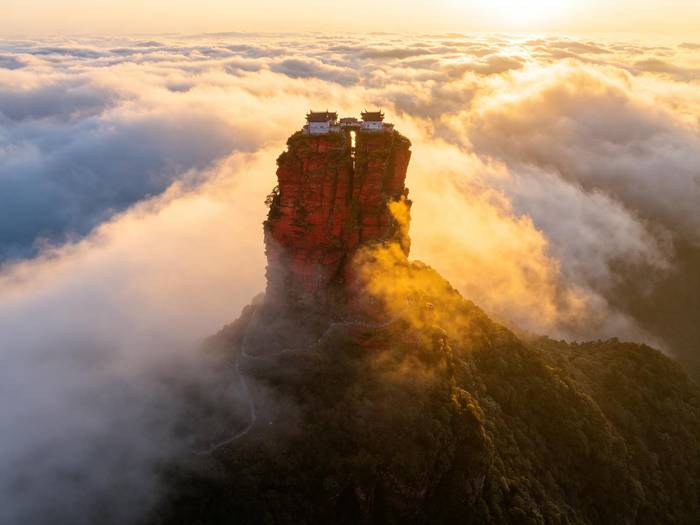
Mount Fanjing needs three to four hours on the mountain and a full day from Guiyang. Its Hongyun Golden Summit sits at 2,336 metres, where two peaks are linked by a narrow bridge above a sea of cloud. The site is a UNESCO World Heritage property and one of the most distinctive landscapes in southwestern China. This guide covers the two approaches, the compulsory cableway package, the climb itself, and the weather judgement that often decides whether you see the summit or its cloud cover.
Which approach should you take?
The east trail from Jiangkou is the route most visitors use. It is served by a cableway that removes the long, repetitive climb through the forest, leaving the steep final section to the summit. Allow three to four hours for the whole visit. The east approach is the right choice for almost every first-time visitor and for anyone coming from Canada on a limited itinerary, because it converts travel time into time on the mountain rather than time on a forest path.
The west trail from Yinjiang is longer and more exposed, favored by hikers who want a harder day. It takes more time and does not suit every itinerary. It involves a longer climb to the ridge and fewer facilities along the way, and it should only be considered by travellers with relevant hiking experience and a full day to spare. Our small-group tours use the east approach because it gives more time on the summit and less time on an access road. Travellers who want a longer walk can add a section below the cableway on a private itinerary rather than committing to the west route in full.
Why the east trail suits a short holiday
A Canadian visitor typically has limited leave and a long flight in each direction. Spending five hours climbing before reaching the interesting terrain is rarely the best use of that time. The cableway lifts you through the forest in minutes, so the walk that follows is the part that matters: old-growth trees, temple courtyards, the ridge and the summit. A guide can also turn you back at a sensible point if the weather closes in, which is a real possibility at this altitude.
Tickets, reservations and the cableway package
A compulsory local package covers the return cableway, the park shuttle and insurance. At the time of writing this has been quoted in the region of C$35–40 per person — roughly 180–200 yuan at an indicative rate of one Canadian dollar to 5.2 yuan. That figure is a working guide only: the rate moves and local fees change, so verify the current amount with the official source before travel. The main entrance ticket is separate from the package and is included in the tour price. All of this is itemised in the written quote so you are not asked to guess at the total on the mountain.
Advance reservation is normal in peak season, and timed entry slots can be limited on summer weekends and public holidays. Your travel consultant handles the booking and confirms the entry time before departure. Travellers booking independently should use the official scenic-area channels and check the current rules directly. Entry rules, ticket prices and shuttle arrangements change — verify the current conditions with the official source before travel.
Carry the passport used at booking. Mount Fanjing uses real-name ticketing, and the name on the reservation must match the document at the gate. Keep the passport on you during the visit rather than leaving it on the coach, because the cableway and shuttle checks may ask for it again.
What is the climb actually like?
From the upper cableway station, a stepped path climbs through old-growth forest before breaking into open rock. The final stretch to Hongyun Golden Summit is steep, with metal ladders and narrow sections. It is not technically difficult, but it demands steady footing and a head for heights. The last thirty minutes are the hardest, and most travellers find that a slow, continuous pace works better than frequent stops.
The Mushroom Rock, a balanced stone formation on the ridge, is the other signature sight. On clear days the view stretches across layered mountains; in cloud, the summit above the white floor is the reward. Both states are worth the climb, and neither is guaranteed. The bridge between the two peaks is narrow and can feel exposed; a guide will tell you when the queue is shortest and when the wind makes crossing unwise.
A realistic minute-by-minute ascent
The following is an indicative shape for an east-trail visit. Your guide adjusts it to the cableway queue and the weather.
- Arrival at the east gate. Passport check, ticket validation and boarding the park shuttle.
- Shuttle to the cableway base. A winding road through the valley; allow twenty minutes.
- Cableway ascent. A swift ride that saves hours of climbing. Queues are longest late in the morning.
- Forest walk to the temple level. Shaded steps through old-growth trees, the gentlest part of the walk.
- Final climb to the Golden Summit. Metal ladders and narrow rock steps, roughly thirty minutes.
- Summit time. The bridge, the two peaks and, on a clear day, the long view. Twenty to thirty minutes is enough.
- Descent by the same route. Allow as long coming down as you did coming up; knees feel the steps.
A mountain day that starts early is a safer day. Late starts compress the schedule and leave you descending in the afternoon cloud that often builds from the east.
What will you actually see on the ridge?
The summit is only part of the story. The route from the upper cableway station passes through forest that has been protected for centuries, with thick moss, old trees and a quiet that visitors often comment on before they reach the rock. Temple courtyards sit along the way, maintained by a Buddhist community; the site has been a place of pilgrimage for a very long time, and the ordination halls and shrines are active, not museum pieces. A guide can explain why the mountain is sacred and how the temples fit into the landscape, which adds a dimension the view alone cannot provide.
Above the tree line the character changes. The ridge narrows, the rock is pale and weathered, and the two peaks of the Golden Summit rise with the bridge between them. The Mushroom Rock sits off to one side, a large stone balanced on a smaller base, and it is a favourite photograph in clear weather. On a cloudy day the outline of the peaks above the white floor can be more striking than any blue-sky view. Travellers often arrive expecting one iconic image and leave with two quite different ones.
The golden summit in different conditions
In full sun, the gilded roofs of the summit buildings catch the light and the long view stretches across the layered mountains of northeastern Guizhou. The bridge between the peaks is busy but the queue moves. In cloud, visibility at the top can drop to a few metres, and the bridge may be closed for safety. Neither condition should be treated as a failure. The forest below remains open in almost all weather, and the temples are worth the visit on their own terms. A guide who knows the mountain will set expectations at the gate so the day is judged on the whole experience rather than on one photograph.
Who is this mountain suited to?
Mount Fanjing suits travellers who want one genuinely dramatic natural sight within a broader Guizhou itinerary. It is not a casual stroll, but with the east cableway it is well within reach of visitors in reasonable health, including many people in their 60s and 70s. The key is honest pacing: the final climb is steep, the steps are continuous, and the descent is harder on the knees than the ascent. A small group with a guide can set a turning point in advance, so nobody feels pressured to continue past their limit.
It is less suited to anyone with a serious fear of heights, significant knee problems, or a tight connection the same evening. For those travellers, the forest route below the cableway still delivers old-growth trees, temple courtyards and the Mushroom Rock view from a distance. Our senior-friendly route guide discusses how to adapt mountain days for older travellers, and a private departure can always shorten the walk without shortening the day.
What should you bring?
Layers are essential — the summit can be 10°C cooler than Guiyang. Wear shoes with grip, carry water and pack a light rain shell. There is limited food on the mountain, so a small snack helps. Travelers with knee problems should discuss the summit climb with their consultant; it is possible to enjoy the forest and the lower viewpoints without going all the way up.
A basic day pack should hold water, a snack, a rain shell, a warm layer, sun protection and a dry bag for the camera. The climb is wet in cloud and bright in sun, often within the same hour. A walking pole helps on the descent for travellers who value stability. There is no need for technical climbing equipment on the standard visitor route; the metal ladders are fixed and the path is maintained.
If you take regular medication, carry it with you rather than on the coach. The walk to the summit and back takes several hours, and a day pack is not a place to be without essentials. Our before-you-go guide has a fuller packing list for mountain days.
How do you get there?
The drive from Guiyang takes about 2.5 hours to the eastern entrance, and roughly 4.5 hours back at the end of the day. Most visitors combine Mount Fanjing with Zhenyuan Ancient Town overnight, which breaks up the travel and adds a historic river town to the trip. Canadian ordinary passport holders may be eligible for visa-free entry for stays of up to 30 days — verify the current policy and your eligibility with the official source before travel.
Kanghui Travel, founded in 1997 (license L-GZ-CJ00022), offers no-shopping small-group departures with a licensed local guide. Prices in CAD are indicative and confirmed in your written quote, issued within 24 hours, with no payment before you approve the itinerary. The quote states the vehicle, the guide, the entry arrangements and the local package as separate lines.
Sequencing with Zhenyuan
The standard pattern is a morning drive from Guiyang, the mountain climb, then an overnight in Jiangkou or Zhenyuan, followed by a slow morning in the old town before returning to the city. An alternative puts Zhenyuan first and the mountain on the second day. Which one you choose should depend on the weather forecast for the summit: put the mountain on the clearer day. A local operator can reorder the days at short notice; a fixed online itinerary cannot. The Zhenyuan two-day guide explains that pairing in more detail.
How to judge the weather window
Mount Fanjing sits high enough that cloud can roll in from the east in under an hour. A clear morning in Guiyang does not guarantee a clear summit. Ask your guide to check the forecast for the mountain itself, not the city, and be willing to move the climb to the best-looking day of your itinerary.
Many itineraries solve this by pairing the mountain with Zhenyuan Ancient Town. Both can be swapped without losing either sight. A traveler with two nights in the area has a much better chance of a clear summit than one who assigns a single fixed day. This is the strongest practical argument for building a little flexibility into the route: the mountain is the one sight in Guizhou where the weather can genuinely determine whether you see the headline view.
For travelers who want a gentler version, the forest trails below the cableway station still offer old-growth trees, temple courtyards and the Mushroom Rock view from a distance. The Golden Summit is the famous image, but it is not the only reason to visit. A guide can set a turning point in advance so the decision is made before you are tired and cold. If the summit is closed by high wind or heavy rain, that lower route is a full and satisfying day in its own right, and our rainy-season guide explains what alternatives remain open.
Before you fly: a Canadian traveller's checklist
- Entry documents. Verify the current visa-free rules for Canadian ordinary passport holders with the official source before travel, and carry the passport used at booking.
- Payment. Set up a mobile wallet before departure if you plan to use one, and carry a backup card and a little cash. Ask your bank about international transaction fees before you fly.
- Connectivity. Arrange an eSIM or roaming plan in advance, download offline maps of Jiangkou and Guiyang, and save the Chinese name of your hotel.
- Altitude and health. The summit is at 2,336 metres. The change is noticeable but mild for most travellers; anyone with a respiratory condition should consult their doctor before travel.
- Packing. Layers, a rain shell, shoes with grip, water, a snack and sun protection are the essentials for the mountain.
- Language. A licensed guide explains the temple history and the geology, and handles the gate and cableway arrangements.
Common questions
How hard is the hike?
Moderate. The cableway removes the bulk of the ascent, but the last 30 minutes are steep. Fit travelers in their 60s and 70s regularly complete it with a guide; anyone unsure can stop at the temple level and still see the forest and the rock formations.
What if the summit is closed by weather?
High winds and heavy rain sometimes close the top. Your guide will check conditions on arrival and adjust the route. This is a normal part of mountain travel, and the lower forest remains open. Ask your consultant how weather substitutions are handled in the written itinerary before you pay.
Can I do Mount Fanjing as a day trip?
Yes, though it is a long day. The two-day option with an overnight in Jiangkou or Zhenyuan is more relaxed and is our recommendation for travelers coming from Canada. It also gives you a second chance at a clear summit.
Is the cableway compulsory?
The return cableway is part of the standard local package on the east route. The package also includes the park shuttle and insurance, and its current cost is itemised in the written quote. Verify the current amount with the official source before travel.
Do I need a head for heights?
The final ladder section and the summit bridge are exposed. Most travellers manage them with a guide close by. If heights are a concern, stop at the temple level and enjoy the forest and the Mushroom Rock view instead; the day is still worthwhile.
When is the summit clearest?
Autumn and winter tend to offer more stable visibility, while summer brings dramatic cloud and faster changes. Because conditions vary day to day, the practical answer is to give the mountain two possible days within your itinerary. Our best-time guide compares the seasons.
Plan your ascent
See two- and four-day routes featuring Mount Fanjing and Zhenyuan, or design a private itinerary with a dedicated consultant. Our before-you-go guide covers weather and packing. A written quote in Canadian dollars follows within 24 hours, and no payment is required before you approve your itinerary.