Most travelers need a night and a morning in Zhenyuan Ancient Town, not a rushed afternoon. The town sits where the Wuyang River bends through steep hills, and its old docks, crooked lanes and covered bridges are at their best after the day visitors leave. Pair it with Mount Fanjing, about three hours away, and you have one of Guizhou's strongest two-day combinations. This guide covers where to stay, what to see on the river, and how to sequence the days so the mountain gets its clearest weather.
Why a night matters here
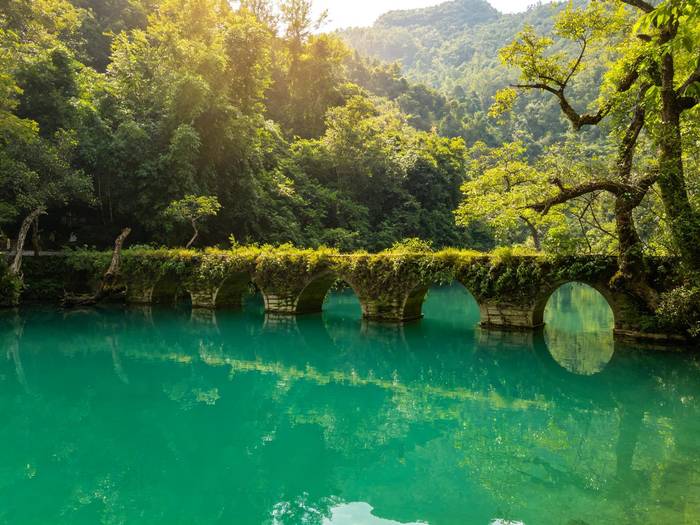
Zhenyuan is a river town with a history shaped by transport. Goods once moved along the Wuyang River, and the old docks, warehouses and guild halls reflect that commercial past. During the day the riverbank is busy with tour groups moving between the covered bridges and the temples. In the evening those groups leave on coaches, and the town settles into a slower rhythm. The lit bridges and their reflections in the water are the signature image, and they are best enjoyed without a crowd pressing behind you.
A night also gives you the morning market and the first light on the river. Before the tour groups arrive, the old docks are quiet and the reflections are clean. The light changes quickly between the high hills, so the first hour after sunrise is the most rewarding for anyone with a camera. Travellers who visit for an afternoon see the town at its busiest and miss the two hours when it is most itself.
What should you see on the river?
Start at the old docks, where stone steps run down to the water and boats once loaded goods for the wider province. The city wall follows the ridge above town; a slow climb gives you the layout of the place in ten minutes. From up there you can see how the town is squeezed between the water and the hillside, which makes the odd street pattern entirely logical.
The lanes are the real attraction. Many houses are built at odd angles to the street — a local feature often described as "crooked doors and sideways paths." Your guide can explain how the geometry reflected both feng shui and the limited flat ground. Rather than following a single route, allow time to wander uphill away from the river, where the houses are older and the shops give way to homes. Two covered bridges cross the river within walking distance, and both are worth crossing in the evening for the view back toward the lit waterfront.
After dark, walk the riverbank. The lit bridges and their reflections in the Wuyang River are the town's signature image, and the walk is gentle enough after a long day on the mountain. A slow thirty minutes along the water, with a stop at each bridge, is the ideal end to the day.
A two-day walk, step by step
The following is an indicative sequence for the two-day Mount Fanjing and Zhenyuan combination. Your written quote confirms the exact hotel and transfer times, and your guide may reorder the days around the mountain weather.
- Afternoon of day one — Arrive in Zhenyuan. Check in near the river, then walk the waterfront and the two covered bridges before dinner.
- Evening of day one — River walk. The lit bridges and their reflections, at a gentle pace after the transfer.
- Early morning of day two — Old docks and market. The quiet hour after sunrise, with breakfast at a local noodle shop.
- Late morning of day two — City wall and lanes. The climb to the ridge, then a wander through the crooked lanes above the river.
- Midday of day two — Lunch and departure. A local meal before the transfer back toward Guiyang or onward to the next stop.
If the mountain is scheduled for day two instead, reverse the pattern and give the town the evening of day one. That way the river walk still happens, and the clearer day goes to the summit.
Where should you stay?
Inside the old town if you can. A guesthouse near the river puts the evening walk and the morning market within easy reach. Rooms in historic buildings can be small and the lanes steep, so travelers with large suitcases should ask for a hotel with vehicle access. If you are carrying more than one bag each, a property on the waterfront with a road at the door is worth choosing over a more atmospheric guesthouse up a flight of stone steps.
Kanghui Travel's two-day Mount Fanjing and Zhenyuan itinerary includes one night in Jiangkou or the old town, chosen for the season and the group. A consultant confirms the exact property in your written quote. Ask whether breakfast is included, whether the room has its own bathroom, and how far it is from the river — those three answers tell you most of what you need to know.
Choosing between Jiangkou and Zhenyuan
Jiangkou is closer to the Mount Fanjing entrance and makes an early mountain start easier. Zhenyuan is the more interesting town to walk in the evening and the morning. If your priority is the summit, sleep in Jiangkou; if it is the river town, sleep in Zhenyuan. A private itinerary can do one night in each on a longer route. On a standard two-day trip, most travellers from Canada prefer Zhenyuan because the evening walk is the part they remember.
How does Zhenyuan pair with Mount Fanjing?
The standard sequence is a full day on Mount Fanjing, an overnight in Jiangkou or Zhenyuan, then a morning exploring the old town before returning to Guiyang. The alternative — visiting Zhenyuan first — works equally well if your guide checks the mountain weather and puts the summit on the clearer day.
This is the sort of sequencing that matters in Guizhou, where mountain conditions change quickly. A local operator can reorder the days at short notice; a fixed online itinerary usually cannot. The mountain is the one sight in the province where weather can decide whether you see the headline view, so a flexible two-day pairing is worth more than a rigid one. Our Mount Fanjing guide explains the east and west approaches and how the cableway changes the day.
The drive between the two is roughly three hours, which is long enough to justify an overnight but short enough to keep the pair within a two-day frame. Add a third night and the route can continue east to Xijiang Qianhu Miao Village or west toward the classic loop.
When is the best time?
Spring and autumn offer comfortable walking weather and clear river light. Summer is busy but lively, and the river is at its most attractive. Winter is quiet; the town takes on a different character when the crowds thin and the mist sits low on the water.
Rain is common in summer and the river rises, but the covered bridges and the stone steps are built for it. A light rain shell and shoes with grip are enough. The evening walk is still pleasant in light rain, and the reflections can be especially good. Our rainy-season guide covers what a wet week means for the province as a whole.
Canadian ordinary passport holders may be eligible for visa-free entry for stays of up to 30 days — verify the current policy and your eligibility with the official source before travel. Prices in CAD are indicative and confirmed in your written quote, issued within 24 hours, with no payment before you approve the itinerary. Entrance tickets and local shuttle arrangements can change; verify current conditions with the official source before travel. As a working conversion, we quote in Canadian dollars and treat one Canadian dollar as roughly 5.2 yuan, though the rate moves and any converted figure is indicative until confirmed in writing.
Getting the most from a morning in Zhenyuan
Start early on the riverbank. Before the tour groups arrive, the old docks are quiet and the reflections in the Wuyang River are clean. The light changes quickly between the high hills, so the first hour after sunrise is the most rewarding for anyone with a camera.
Breakfast is part of the experience. Small shops near the river serve noodle soups and steamed buns, and a guide can point out the ones with steady local trade. This is a better introduction to the town than a hotel buffet and costs very little. Ask your guide what is in season; the sour-noodle breakfasts are a local specialty and a gentle introduction to Guizhou's taste for sour flavours.
If you have an extra hour, follow the city wall up to the ridge. The climb is steady rather than steep, and the view explains why the town developed along this particular bend in the river. On a clear day you can see how the old lanes are squeezed between the water and the hillside, which makes the crooked street layout entirely logical. A guide can point out the guild halls and the remnants of the wall, turning a pleasant climb into a short lesson in the town's history.
Before you fly: a Canadian traveller's checklist
- Entry documents. Verify the current visa-free rules for Canadian ordinary passport holders with the official source before travel, and carry the passport used at booking.
- Payment. Set up a mobile wallet before departure if you plan to use one for small shops and breakfast stalls, and carry a backup card and a little cash.
- Connectivity. Arrange an eSIM or roaming plan in advance and download an offline map of Zhenyuan and Jiangkou. Save the Chinese name of your guesthouse in your phone.
- Packing. Bring one small overnight bag, shoes with grip for the stone steps and a light rain shell. The riverbank is cooler in the morning than the afternoon.
- Language. A licensed guide translates at the market and explains the history of the docks and the wall. Our language guide covers the wider picture.
The full checklist is in our before-you-go guide.
A note on the guild halls
Zhenyuan was a trading town, and the guild halls built by merchants from other parts of China are among its most interesting buildings. Each hall served as a meeting place, a lodging house and a place to settle disputes for a community of traders far from home. Your guide can point out the best-preserved examples on the walk above the river and explain how the architecture reflects the regions the merchants came from. Travellers with an interest in history will find an hour here as rewarding as the river walk, and it is a useful option when the weather keeps you off the exposed docks. The halls also show why the town developed at this particular bend in the river: it was a stopping point on a route that connected the interior to the wider province.
Common questions
Is Zhenyuan hilly?
Yes. The old town climbs away from the river. The main riverbank walk is flat, but some guesthouses require a steady uphill walk. Tell your consultant if steps are a concern and choose a waterfront room.
How much time do I need?
One night and one morning covers the highlights. Travelers interested in calligraphy, local history or slow photography often stay two nights, and a third can be used as a base for exploring the surrounding hills.
Can I visit independently?
Yes, but the shuttle from the highway and the ticket arrangements are simpler with a guide. Our two-day tour includes the local shuttle as a clearly listed payment.
Is the evening river walk safe and easy?
Yes. The waterfront is well lit and the walk is gentle. The stone steps can be slick after rain, so wear shoes with grip and keep to the paved sections.
Can I combine Zhenyuan with Xijiang Qianhu Miao Village?
Yes, with a third day. Both sit in the eastern half of the province and the transfer is manageable. A private itinerary can sequence the three stops around your flights.
What happens if it rains?
The covered bridges, the guild halls and the indoor corners of the old town remain interesting in rain. Your guide can shift the river walk to a drier window and spend the wet hour in a teahouse or a small museum.
Continue exploring
Read the Mount Fanjing guide and browse small-group itineraries combining both sites. To extend the trip to Xijiang Qianhu Miao Village, design a private route. A dedicated consultant will send a written quote in Canadian dollars within 24 hours and ask for no payment before you approve the itinerary.