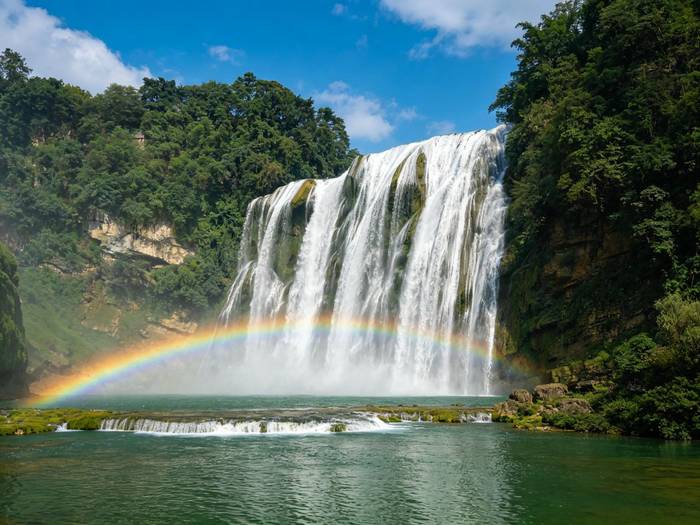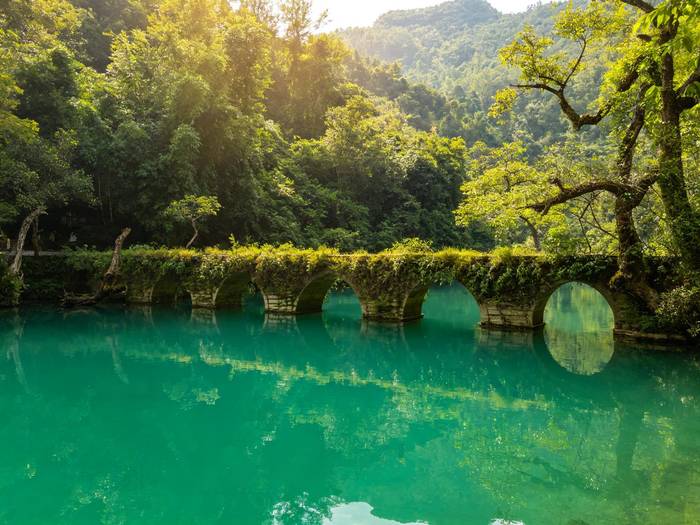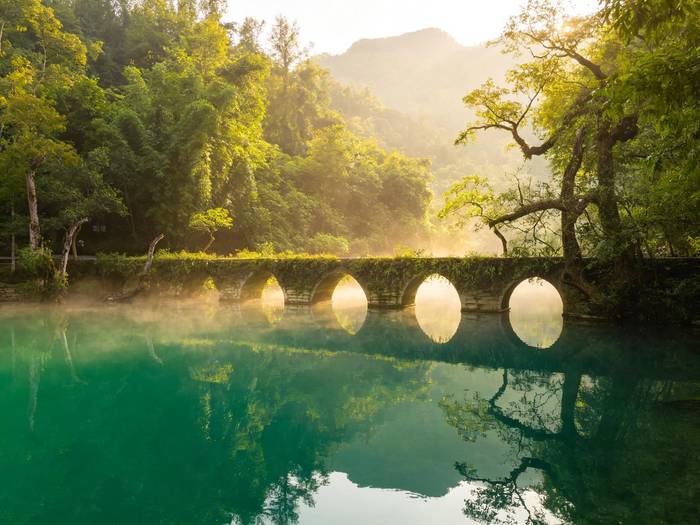
The efficient five-day Guizhou loop runs Guiyang → Xiaoqikong → Xijiang Qianhu Miao Village → Huangguoshu Waterfall → Guiyang. That order follows the geography instead of bouncing between sites, and it keeps each major stop to a full visit rather than a drive-by. Most travelers need five days to see the three names properly. This guide sets out the sequence, the drive times, the trade-offs and the bookings that need to be made first.
Why does the order matter?
Xiaoqikong lies south of Guiyang and Xijiang sits east of it; Huangguoshu is west. Starting with the long southern drive and finishing with the western day means the roads roughly form a circle. A common mistake is to visit Huangguoshu first, return to Guiyang, then head south — adding hours of duplicate driving. The circle is not the only reason for the order, but it is the clearest one to explain: you never cross the same stretch of road twice without a reason.
The loop also puts the overnight in Xijiang on night two or three, so you experience the village after the day groups leave. That single decision changes the quality of the trip. A day visitor sees the lanes at their busiest; an overnight guest sees the lights come on across the hillside and the mist at dawn. If you only change one thing about a standard itinerary, make it this: sleep in the village rather than passing through it. Our Xijiang overnight guide explains why in more detail.
What a circle looks like on the map
Imagine Guiyang at the centre. Xiaoqikong is a long drive south; Xijiang is east of the city; Huangguoshu is west. A loop that goes south, then east, then west back to the centre avoids retracing any leg. The distances are real — this is mountain travel, not a city metro — and a day that looks short on a map can take four hours on the road. Sequencing the route as a circle is the simplest way to turn those kilometres into scenery rather than repetition.
Day-by-day shape
The following is an indicative outline. Your written quote confirms the exact hotel category, vehicle and departure times, and your guide may adjust the order around weather and crowds.
Day 1 — Arrive Guiyang
A private transfer takes you to your hotel. The afternoon is free for Jiaxiu Tower or a first meal of sour soup noodles. Keep this day light: after a long flight from North America, the body needs a slow start. A walk along the river and an early night set up the week better than a packed schedule. If you arrive early enough, the old city lanes and a teahouse are a gentle introduction to the province.
Day 2 — Xiaoqikong
Roughly four hours on the road, then at least three hours among the old bridge, the cascades and the Water Forest. Continue to Xijiang for the night. The east-to-west route through the park follows the water downhill and ends at the 1836 stone bridge; the Xiaoqikong guide walks the sequence in full. The drive onward to the Miao village is shorter than the return to Guiyang, which is why this day is built the way it is.
Day 3 — Xijiang
Stilt houses, the living museum, the viewing terrace and a long-table lunch. Afternoon transfer toward Guiyang or Zhenning. Use the morning for the quiet lanes and the rice terraces above the village, when the day groups have not yet arrived. The evening viewpoint belongs to the previous night, so this day can be slower. If photography matters to you, this is the day to ask your guide for the quieter upper terrace and a longer window at the viewpoint.
Day 4 — Huangguoshu
About 2.5 hours from the overnight stop, then four to five hours across Doupotang, Tianxing Bridge and the Grand Waterfall. The internal shuttle links the zones, and the path behind the curtain of water is the highlight. A rain shell and a dry bag are worth carrying. The waterfall guide gives the hour-by-hour detail and explains the local shuttle payment.
Day 5 — Depart
Depending on your flight, a short morning in Guiyang or a direct transfer to the airport. If your flight is late, the morning is a good time for the city market or a final meal. Allow a generous buffer for the transfer; mountain roads and city traffic do not behave predictably, and a missed international connection is a costly way to end a good trip.
Who should choose this loop?
It suits travelers with limited leave who want the province's headline sights without a rushed daily schedule. For travelers 55 and over, a small group with a licensed guide removes the navigation and ticket friction; the pace is steady and the hotels can be upgraded. For travelers in their 30s and 40s who want more control — a longer photography window in the Miao village, say — the same loop works as a private customized tour.
Solo travellers often choose the small-group version for the company and the predictable cost. Families with children can use the private version to shorten walks and keep meal times flexible. The route itself does not change with the format; what changes is how much of each day belongs to you. Our group-size comparison sets out the differences in pacing and cost in more detail.
What is not included?
International flights to Guiyang are arranged separately, and the scenic shuttles are paid locally as clearly listed packages. Kanghui Travel's published price covers the main entrance tickets, the coach or vehicle, the listed meals, insurance and the guide. Everything else is itemized in the written quote so the budget stays predictable — a point that matters especially to travelers who want to pay in Canadian dollars.
Canadian ordinary passport holders may be eligible for visa-free entry for stays of up to 30 days — verify the current policy and your eligibility with the official source before travel. Ticket prices, shuttle arrangements and entry rules can change; verify the current figures and conditions with the official source before travel. As a working conversion, we quote in Canadian dollars and treat one Canadian dollar as roughly 5.2 yuan, though the rate moves and any converted figure is indicative until confirmed in writing. For a fuller account of the four cost buckets, see the six-day cost breakdown.
What to book and when
Hotels inside or near Xijiang Qianhu Miao Village are the first item to secure, because the good ones are limited and the summer weekends fill quickly. Book the loop at least two weeks ahead in shoulder season and earlier in July and August. A written quote should name the hotel category for each night rather than leaving it as "similar standard." If a particular guesthouse with a valley view matters to you, say so at the request stage; it can usually be held for a small group or a private departure.
The second decision is the vehicle. A 2+1 coach is comfortable for the longer legs and better value for a group; a private car suits couples and families who want to stop when they like. Both work on this loop. What matters is that the driver knows the route and that the pickup is included. Ask whether the vehicle is reserved for your group alone or shared, because that changes both the pace and the boarding time.
Finally, decide how much free time you want in Guiyang. A loop that ends with an evening flight leaves no room for the city, while an extra night lets you see Jiaxiu Tower and eat properly before flying home. Most travelers coming from Canada appreciate that buffer after a long sequence of early starts. Our before-you-go guide covers the entry, payment and connectivity details that make the first and last days easier.
A note on bags and transfers
Pack for the loop as you would for a moving week: one main bag and one small overnight bag. The village guesthouse may require carrying your belongings up stone steps, and a smaller bag makes that manageable. Your consultant can note mobility needs in advance so the room and the vehicle drop-off are chosen with them in mind. This is a small detail that has an outsized effect on how relaxed the Xijiang night feels.
How each day actually feels on the ground
A five-day loop is often described in terms of sights, but the experience is shaped by the transitions between them. Understanding the rhythm helps you pack and set expectations. The two long road days are day two to Xiaoqikong and the transfer after Xijiang; both are several hours in a vehicle, and both are more pleasant with a small group that boards quickly and a guide who plans the comfort stops. The remaining days involve shorter transfers and more time on foot.
The walking varies more than travellers expect. Xiaoqikong has a mostly flat boardwalk with one wet section through the Water Forest. Xijiang is steep, with stone steps up to the viewing terrace. Huangguoshu uses a shuttle between zones and paved paths with steps behind the waterfall. None of these is technically difficult, but three consecutive days of steps are tiring if you are not used to them. A small group lets you take the gentler version of each route, and a private itinerary can shorten a walk without removing the sight. If mobility is a concern, say so before booking so the vehicle drop-off and the room location can be chosen with that in mind.
Meals are another part of the rhythm. Most itineraries include breakfasts and a set number of lunches or dinners, with the rest left open. This is deliberate: Guizhou's food is a real part of the trip, and being free to choose a noodle shop or a village table is a feature, not a gap. Tell your consultant about dietary requirements at the request stage, because vegetarian and less spicy options are easier to arrange in advance than on the road. Our food guide introduces the specialties you are likely to meet.
Why the overnight stops are placed where they are
The loop uses Xijiang as its main overnight outside Guiyang because it is the one site that changes character after dark. Staying there turns a sightseeing stop into an experience. The other nights are in Guiyang or near the waterfall, chosen to keep the drives short the following morning. If your flights allow, adding an extra night in Guiyang at the end gives you a buffer and a chance to see the city properly. That small addition is one of the most common upgrades travellers choose once they understand the pace of the route.
Before you fly: a Canadian traveller's checklist
- Entry documents. Verify the current visa-free rules for Canadian ordinary passport holders with the official source before travel, and carry the passport used at booking.
- Payment. Set up a mobile wallet before departure if you plan to use one, and carry a backup card and a little cash. Ask your bank about international transaction fees.
- Connectivity. Arrange an eSIM or roaming plan in advance and download offline maps of Guiyang, Libo and Anshun. Save each hotel's Chinese name in your phone.
- Packing. Layers, a rain shell, shoes with grip, sun protection and any regular medication in hand luggage. The loop covers forest, hillside and riverbank in five days.
- Language. A licensed guide handles the real-name ticket checks and translates at each site. Our language guide covers the wider picture.
Common questions
Can I shorten it to four days?
Yes, by removing the full Xijiang morning, but the village then becomes an overnight with no real exploration. Five days is the sensible minimum for all three sites.
Can I add Mount Fanjing?
Add at least one day, and preferably two if you want to include Zhenyuan Ancient Town. Our six-day itineraries show one workable version, and the seven-day itinerary adds more depth.
Is this a shopping tour?
No. Kanghui Travel's small-group departures are pure sightseeing with no shopping stops, and the written itinerary states that. Our no-shopping guide explains how to read any itinerary for yourself.
Can I do the loop in reverse?
Yes, and it may suit your flights better. The important thing is that the route forms a circle rather than repeating the same road. Your consultant can sequence the days around your arrival and departure times.
What if it rains during the loop?
Most sites remain open, and the waterfalls look dramatic after rain. Your guide can reorder the days and substitute an indoor sight such as a cave if needed. Ask how weather substitutions are handled before you pay.
Plan your loop
Browse five-day small-group tours or design a private five-day itinerary. Our before-you-go guide covers visas, payments and connectivity. A dedicated consultant will send a written quote in Canadian dollars within 24 hours, and no payment is required before you approve the itinerary.