Seven days is the point where a Guizhou trip stops being a checklist and starts feeling like a journey. The classic three sites still anchor the route, but the extra days allow a night in Zhenyuan Ancient Town, a proper ascent of Mount Fanjing and a slower final morning in Qingyan. This guide sets out a workable sequence, explains where flexibility earns its keep, and shows how to decide whether a private itinerary is worth the additional cost.
A workable seven-day sequence
The following is one version of a seven-day route. Your written quote confirms the exact hotels, vehicle and transfer times, and your guide may reorder the days around the mountain weather.
Day 1 — Arrive in Guiyang
Private transfer to your hotel, then a free afternoon. Keep it light after the long flight from North America: a walk to Jiaxiu Tower, a first meal of sour soup noodles and an early night. A gentle start is the best way to protect the rest of the week.
Day 2 — Huangguoshu Waterfall
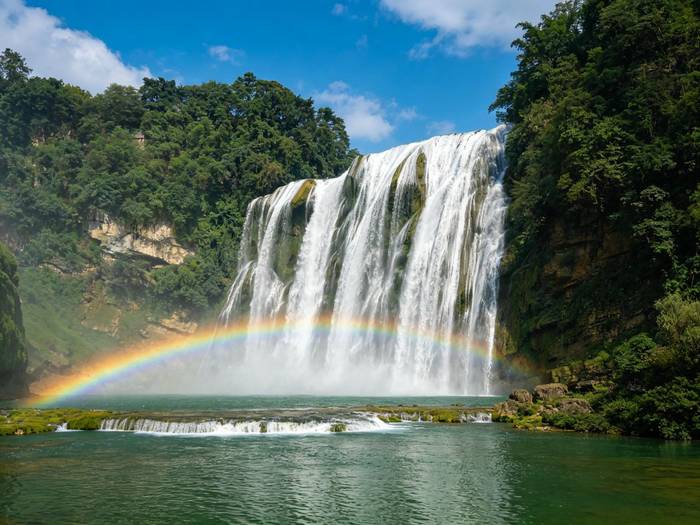
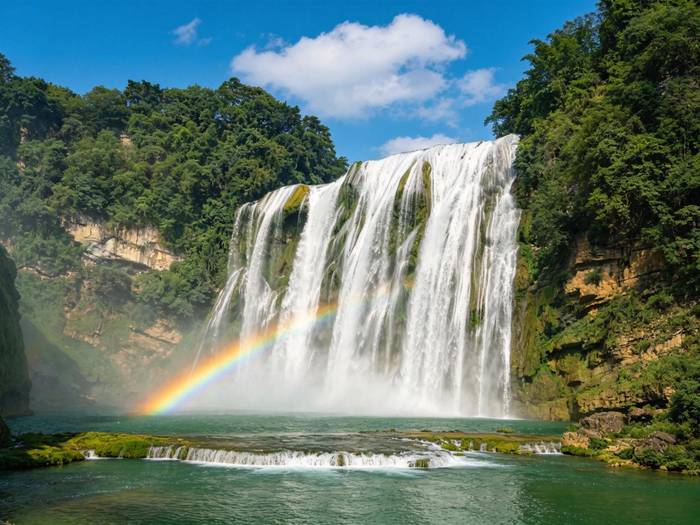
Doupotang, Tianxing Bridge and the Grand Waterfall, with the internal shuttle linking the zones. The path behind the curtain of water is the highlight, so carry a rain shell and a dry bag. The full day is described in the Huangguoshu guide.
Day 3 — Xiaoqikong to Xijiang
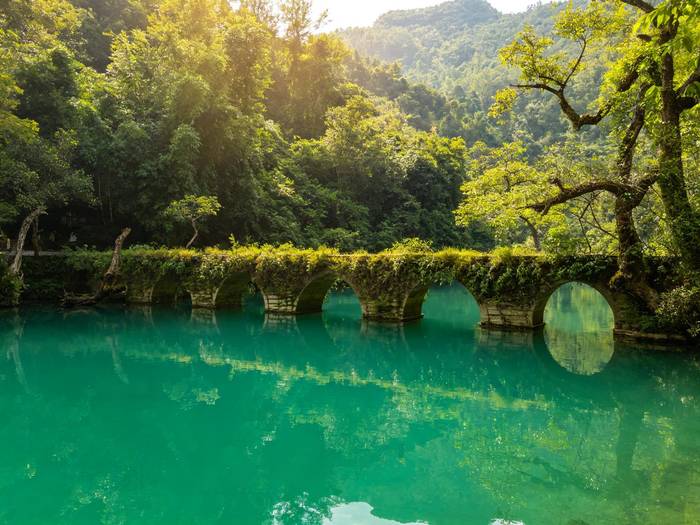
Drive to Xiaoqikong for four hours on the water trail, then continue to Xijiang Qianhu Miao Village for the night. The east-to-west route through the park ends at the 1836 stone bridge, and the drive onward to the village is shorter than returning to Guiyang. See the Xiaoqikong guide for the route in detail.
Day 4 — Xijiang to Zhenyuan
Village morning, long-table lunch, then the drive to Zhenyuan. Evening walk along the Wuyang River, when the covered bridges are lit and the reflections are clean. The Zhenyuan guide explains what to see on the river and in the lanes above it.
Day 5 — Mount Fanjing
The east trail and the cableway to Hongyun Golden Summit at 2,336 metres, then an overnight back in Guiyang or near the mountain. The weather forecast for the mountain, not the city, should decide when this day falls. The Mount Fanjing guide covers the climb and the local package.
Day 6 — Qingyan Ancient Town
Ming and Qing lanes, old walls and a long lunch, with time to wander without a schedule. Qingyan is close enough to Guiyang for a relaxed day and different in character from the natural sights that dominate the rest of the week. It is a good place to slow down before the flight home.
Day 7 — Departure
Timed to your flight or train, with a transfer to the airport. If the flight is late, the morning is free for last purchases or a final meal. Allow a generous buffer for the transfer rather than cutting it fine.
This is one version. A private itinerary can swap the order based on the mountain weather, add a photography window at Wanfenglin, or replace Qingyan with a textile village. The sequence is a framework, not a contract.
Why flexibility matters here
Guizhou's mountain weather changes faster than a fixed online itinerary can respond. If high wind closes the summit on your scheduled day, a private guide can move Mount Fanjing forward and put Zhenyuan on the following morning. That kind of same-day adjustment is the strongest practical argument for traveling with a local operator rather than assembling the pieces yourself. The alternative is to accept that one of the headline sights may be missed for reasons nobody can control.
Travelers in their 30s and 40s often use a private customized tour for exactly this reason: they want the route to bend around their interests rather than the other way around. Travelers 55 and over tend to value the same flexibility for a different reason — predictable pacing and a guide who can shorten a walk without shortening the day. Both are legitimate uses of a private departure, and neither requires changing the sights on the itinerary.
Building a weather buffer into the week
The simplest way to protect a seven-day trip is to leave one day with two possible uses. In practice that means keeping the Mount Fanjing day and the Zhenyuan or Qingyan day adjacent, so they can be swapped. If the mountain is clear on day four, go then and walk the river town on day five. If it is closed in cloud, do the reverse. A local operator can make that call at short notice; a fixed booking cannot. It is worth asking your consultant to write the swap into the itinerary before you pay, so the rule is agreed rather than improvised. Our rainy-season guide explains what a wet week looks like across the province.
What about the group size?
Our seven-day route runs as a small group capped at eight travelers, with a Mandarin-speaking driver and local coordination. A licensed guide can be added for travelers who want interpretation throughout. A private vehicle and guide is available for couples and families who prefer to travel alone.
The small-group version suits travellers who want company and a predictable cost, with the flexibility that comes from a shorter vehicle and quicker stops. The private version suits anyone who wants the day to respond to them — photographers waiting for a second light window, families with different walking abilities, or travellers who simply prefer their own company. Our group-size comparison sets out the trade-offs in detail.
What should you budget for?
The land price covers hotels, the vehicle, entrance tickets and breakfasts. Scenic shuttles and the cableway are listed as local payments, roughly C$70 across the full route — about 358 yuan at an indicative rate of one Canadian dollar to 5.2 yuan. That figure is a working guide only: the rate moves and local fees change, so verify the current amounts with the official source before travel. International flights are separate. Prices in CAD are indicative and confirmed in your written quote, issued within 24 hours, with no payment before approval.
Canadian ordinary passport holders may be eligible for visa-free entry for stays of up to 30 days — verify the current policy and your eligibility with the official source before travel. Ticket prices, opening hours and shuttle arrangements can change; verify the current conditions with the official source before travel. For a full account of how a multi-day quote is assembled, see the six-day cost breakdown.
Where a private itinerary earns the extra cost
The clearest case is photography. Light at Wanfenglin and the terraces is good for perhaps two windows a day, and a fixed group schedule rarely lets you wait for the second one. A private car and guide can hold the afternoon open and move dinner later. The same applies to the Miao villages, where the best hours are early morning and after the day groups leave. A private itinerary can put you on the upper terrace at dawn without negotiating with a coach schedule.
The second case is multi-generational travel. If one member of the party prefers a shorter walk, a private itinerary can split the group without anyone missing the day. A guide stays with the person who needs support while the others continue, and you regroup for the transfer. This is difficult to arrange in a large group and straightforward in a private one.
Travelers in their 30s and 40s often combine those two reasons: they want depth and they want the day to respond to them. A seven-day private route is not dramatically more expensive than a series of small-group bookings once you account for the included guide and the flexibility, especially for a group of three or four. Ask for both options in writing and compare the inclusion lines, not just the totals. If you want to design your own version, start a private itinerary.
How seven days differ from five
Travellers often ask whether the extra two days are worth adding. The answer depends on what you want from the trip. A five-day loop covers the three headline sights and does it well, but it leaves little room for weather changes and almost none for the quieter places that give Guizhou its character. Seven days adds exactly those things: a river town with its own history, a serious mountain ascent, and an old town day close to the capital.
The difference is felt in the pace as much as in the list of sights. On a five-day loop, most mornings start early and the itinerary has to be followed closely. On a seven-day route there is enough slack to spend an extra hour in the Xijiang lanes, to move the mountain day to a clearer morning, or to take a long lunch in Qingyan without watching the clock. For travellers who have flown halfway around the world, that slack is often the difference between a trip that is enjoyable and one that is merely completed. The five-day loop is the useful comparison if you are weighing the two.
What the two extra days cost
The additional days add hotel nights, two more days of vehicle and guide, and the local package at Mount Fanjing. They do not double the price, because the fixed costs of the trip are already covered in the first five days. A seven-day private route for a group of three or four can work out competitively against several separate small-group bookings, particularly once the included guide and the flexibility are counted. Ask for both options in writing and compare the inclusion lines rather than the headline totals. Our six-day cost breakdown explains the four buckets and how to read a quote honestly.
Before you fly: a Canadian traveller's checklist
- Entry documents. Verify the current visa-free rules for Canadian ordinary passport holders with the official source before travel, and carry the passport used at booking.
- Payment. Set up a mobile wallet before departure if you plan to use one, and carry a backup card and a little cash. Ask your bank about international transaction fees.
- Connectivity. Arrange an eSIM or roaming plan in advance and download offline maps of every city and county on the route. Save each hotel's Chinese name in your phone.
- Packing. Layers, a rain shell, shoes with grip and any regular medication in hand luggage. Seven days covers mountain, forest, river and old town.
- Language. A licensed guide handles the real-name ticket checks and translates at each site. Our language guide covers the wider picture.
The full checklist is in our before-you-go guide.
Who this itinerary suits best
Seven days suits travellers who have the time to go slowly and who value variety over repetition. It works particularly well for a first visit to Guizhou, because it combines the headline natural sights with the two things that give the province depth: a living Miao village and a historic river town. It also suits a second visit from travellers who saw the classic loop on an earlier trip and want to add the east and the mountain.
For travellers over 55, the small-group version offers structure and company while the extra days remove the pressure to rush. A guide handles the tickets, the pace is steady, and the hotel nights are concentrated in places with good road access. For travellers in their 30s and 40s, the private version turns the same route into something more personal, with photography windows and flexible meal times. Families can use the private version to split the group when walking abilities differ. In each case the sights stay the same; it is the amount of choice around them that changes.
If you are uncertain whether seven days is right for you, start with your available leave and your tolerance for long drives. Travellers who can spare the week almost never regret the extra days, because the slack they create is what makes the mountain day work in imperfect weather. Those on a tighter schedule are better served by the five-day loop, which is complete in its own right.
Common questions
Is seven days too long for Guizhou?
Not if you use the time for depth. Adding a second night in Xijiang or a day in southern Guizhou's peak country is more rewarding than compressing the route. Seven days is also a sensible length if you are flying from Canada and want to recover from the time difference.
Can children join?
Yes. The long drives are the main consideration; a private vehicle makes them easier. Tell your consultant the ages so the daily pacing can be adjusted, and build in the odd free afternoon.
What if I want more hiking?
A guide can add a longer section on Mount Fanjing's west approach or a village-to-village walk. Difficulty is graded in discussion with you before booking. The standard route uses the cableway to keep the walking focused on the interesting terrain.
Can I swap Qingyan for something else?
Yes. A textile village, a longer stay in Zhenyuan or a day in the southern peak country are all workable on a private itinerary. The small-group version keeps Qingyan because it is close to Guiyang and easy to schedule.
How far ahead should I book?
In shoulder season, two weeks is usually enough for a small group. In July, August and around public holidays, reserve as early as your dates allow. In-village accommodation at Xijiang is the first item to secure.
Plan your week
Browse seven-day small-group routes or design a private seven-day itinerary. A dedicated consultant will send a written quote in Canadian dollars within 24 hours, and no payment is required before you approve the itinerary.